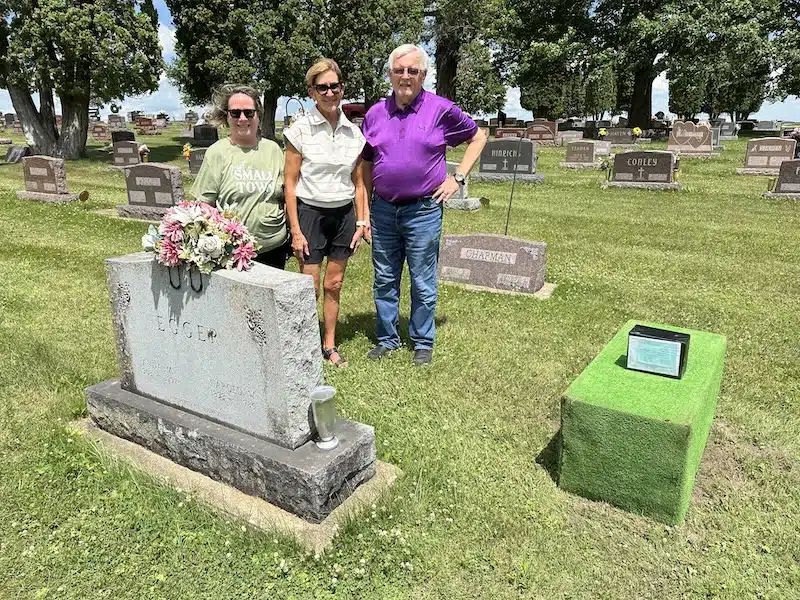
Audrey Egger, whose roots were in Monticello, IA, married Richard Pierce and they settled in Florida. Audrey’s last desire was to have her ashes returned home, to Monticello, and be buried next to her parents, Harold & Ann Egger. Harold & Ann were longtime friends, and supporters of Camp Courageous. Thanks to those pictured above, who did the above and beyond, Audrey’s wishes were fulfilled. (L-R) Sheryl Harbaugh (Kathy Swift’s sister-in-law), from Manchester; Kathy Swift-(2nd cousin of Audrey Egger), from Manchester; and Kevin Smith (Funeral Director & CEO Goettsch’s Funeral Home) from Monticello.
I have sometimes been criticized for not throwing away anything. I decided to take a long shot and went to the basement of our offices and looked through some of my old ‘People’ files. And there was a file I established over two decades ago entitled Dick & Audrey Pierce. In the file was the Pierces and the Eggers history of giving to Camp Courageous. Then attached to the file was a note I had made for myself. A phone call from Audrey Pierce on 7/29/02 at 9 AM…stating she was Audrey Pierce from Florida… ‘in her will everything goes to Camp Courageous.’ She mentioned her dad, Harold, died in 1986 and Ann, her mom, in 1997. Her folks lived a short distance from me, and we had been friends. She talked about being from Monticello in 1960s and went to Florida in 1970s. My note continues…. “No Kids-All goes to Camp” along with the date and time of the call.
Unfortunately, Audrey and Richard, met up with a personal financial planner in Florida. That person worked their way into their personal lives and became Power of Attorney, etc. As a result, they went from being very successful, to dying with nothing. As a matter of fact, Richard died when the house he was living in, burned down, with him in it. Over my 46- years at Camp Courageous I have run across too many cases where people have taken advantage of the elderly and the vulnerable. Audrey had high hopes for supporting Camp Courageous in the end…but instead these folks (pictured) and Camp Courageous made her last desires come true. Unlike many, Camp Courageous/Charlie Becker, will not turn our backs when wrong has been done. It is not about the money; it is about stopping bad people from taking advantage of good people. In this case, there was only Dick & Audrey, two very good and caring and wonderful people, who unfortunately were also very vulnerable. Camp had an attorney representing it in this case, and now Camp is recommending the case be turned over to the Florida Attorney General’s Office, for further actions. -Charlie
Financial abuse or exploitation of elderly individuals is a serious issue that can have devastating consequences.
Here’s how to be vigilant and what actions to take if you suspect it:
Recognizing the signs
- Sudden or unusual changes in financial behavior: This can include large or frequent withdrawals, unfamiliar bank accounts or credit cards, changes in spending patterns, and unexplained transfers or purchases.
- Isolation and secrecy: If the elderly individual is being isolated from family or friends, or if a new “friend” or caregiver seems overly involved in their financial matters, it’s a red flag.
- Changes in wills or important documents: Be cautious of abrupt changes to legal documents, particularly if the elder is ill or incapacitated.
- Neglect and substandard care: If bills are going unpaid despite adequate resources, or if the individual is experiencing neglect or inadequate care, it might indicate financial exploitation.
- Fear or anxiety around finances: If the elder appears suddenly fearful, anxious, or reluctant to discuss their finances, they might be experiencing abuse.
Taking protective measures
- Open Communication: Talk regularly with your loved ones about their financial situation, scams, and any concerns they might have.
- Establish a Financial Plan: Help them create a plan that outlines their financial goals and objectives.
- Assign Trusted Contacts: Encourage them to name trusted individuals (family, friends, or advisors) as contacts on their accounts, who can be alerted if there are suspicious activities.
- Monitor Accounts Regularly: Review bank statements, credit reports, and other financial records for any unusual or unauthorized transactions.
- Use Legal Safeguards: Consider establishing a durable Power of Attorney (POA) or a Trust to provide an extra layer of oversight and protection. It’s crucial to choose a trustworthy agent and clearly define their responsibilities and limitations.
- Protect Sensitive Information: Keep personal and financial documents in a secure place and shred any sensitive materials before discarding them.
- Educate and Inform: Share information about common scams and encourage your loved ones to be cautious of unsolicited offers, especially those involving pressure tactics or requests for personal information.
- Vet Caregivers and Advisors: Thoroughly check the backgrounds and references of caregivers or financial advisors who will have access to an elder’s finances.
Reporting suspected abuse
If there is immediate danger, call 911. For suspected financial abuse, contact your local Adult Protective Services (APS), which can be found through the Eldercare Locator or the National Adult Protective Services Association. You should also report suspicious activity to the elder’s bank or credit union and file a report with local law enforcement. National resources are also available, such as the National Elder Fraud Hotline at 833-FRAUD-11 (833-372-8311) and the Eldercare Locator helpline at 1-800-677-1116. Reporting suspected elder financial abuse is vital to stopping exploitation.